

Company History
U-Haul has served the do-it-yourself moving household for over 75 years. Like many other successful ventures, the concept for U-Haul was generated out of need. After World War II, widespread need existed for do-it-yourself moving equipment on a one-way, nationwide basis. U-Haul co-founders L.S. "Sam" Shoen and his wife, Anna Mary Carty Shoen, recognized that need and acted upon it. Their visionary approach shared the cost of ownership among many users, facilitating the mobility of the population of the U.S. and Canada. The covered wagon of the pioneers morphed into orange U-Haul trailers. In the process, an industry was born.
Discharged from the Navy in the summer of 1945, 29-year-old Sam and Anna Mary tried to rent a utility trailer to move their possessions from Los Angeles to Portland, Ore. It couldn't be done. They had to take only what they could fit in the car.
"Small luggage-type passenger automobile trailers were being rented from 'rental lots' in Los Angeles. Each lot had from 20 to 40 trailers which were rented locally for approximately $2 per day," recalled Shoen in his book You and Me. "I recognized that here was an item with considerable utility value which had not been exploited at all in the Northwest or in the San Francisco-Oakland area. I was intrigued with the business potential of this idea, especially from the standpoint of one-way rentals."
The Shoens reasoned that many other families had a need similar to theirs: the short-term availability of a trailer that could be rented "here" and left "there." No one, at that time, seemed ready or willing to serve that need.
With a 1937 Ford and $5,000 in savings, Sam, Anna Mary and their young son moved from Los Angeles to Portland, Ore. During the drive, they came up with the name and formulated the outline of what was to become the U-Haul Trailer Rental System.
The Shoens launched U-Haul in the summer of 1945. The first trailers were bought from welding shops or second hand from private owners. Within two weeks of leaving Los Angeles, the first U-Haul trailer was parked on a service station lot and being offered for rent. By the end of 1945, 30 4' x 7' open trailers were on service station lots in Portland, Vancouver and Seattle, Wash.
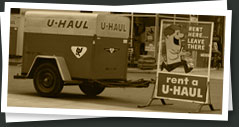
An identity was established. First, the trailers were painted bright orange. Secondly, the name U-Haul Co. was established. Third, trailers were imaged on the sides and back with a sales message - "U-Haul Co.," "Rental Trailers," "$2.00 Per Day" - always advertising themselves whether on the road or on display. Lastly, trailer rentals were merchandised from service station outlets. A commission structure for dealers was established, and much of the early recruitment was done by a customer who was offered a discount on their trailer rental for establishing a U-Haul Rental Agent (now called U-Haul Dealers) at their destination.
The company was not an overnight success. The purchased trailers - generally a frame and tongue built on the running gear of scrapped automobiles, what Sam would later call "junkers" - broke down with painful frequency, often costing more to repair than could be covered by rental fees. That winter, to cut expenses "to the bone," Sam and Anna Mary moved in with her folks on the family ranch. They were broke but believed they had a business. Based on his appearance of success, Sam obtained credit from a local lumber yard and was able to obtain war-surplus steel from a Navy yard.
By the end of 1949, it was possible to rent a trailer one way from city to city throughout most of the United States and by 1955 throughout most of Canada. And the rest, as they say is history. By the end of 1959, the U-Haul Trailer fleet consisted of 42,600 trailers.
Since 1945, U-Haul has been the first choice of do-it-yourself movers, with a network of more than 23,000 locations in all 50 United States and 10 Canadian provinces. U-Haul customers' patronage has enabled the U-Haul fleet to grow to more than 192,200 trucks, 138,500 trailers and 44,500 towing devices. U-Haul offers more than 949,000 rentable storage units and more than 81.2 million square feet of storage space at owned and managed facilities throughout North America. U-Haul is the consumer’s number one choice as the largest installer of permanent trailer hitches in the automotive aftermarket industry. U-Haul supplies alternative-fuel for vehicles and backyard barbecues as one of the nation’s largest retailers of propane.